Blog

  • Post 1: Primary Research on Chinese Animation Practitioners

    For my primary research, I made some interviews. I sent out five questionnaires in total and received four valid responses. This post focuses on two professional animation practitioners from China.

    The first interviewee is Shui Yu. He is an animation film director and also a university animation tutor. The second interviewee is Lei Yang. She graduated from the MA Animation course at London College of Communication and now works as a freelance animation director and animator.

    I chose these two practitioners because they represent two very different animation career paths in China. Shui combines university teaching with personal creation, while Lei works as a full-time freelance animator. Comparing their experiences helps me understand different working locations, career opportunities and real work pressures in the Chinese animation industry.

    Note: All original interview answers were in Chinese. I translated them into English for this journal post.
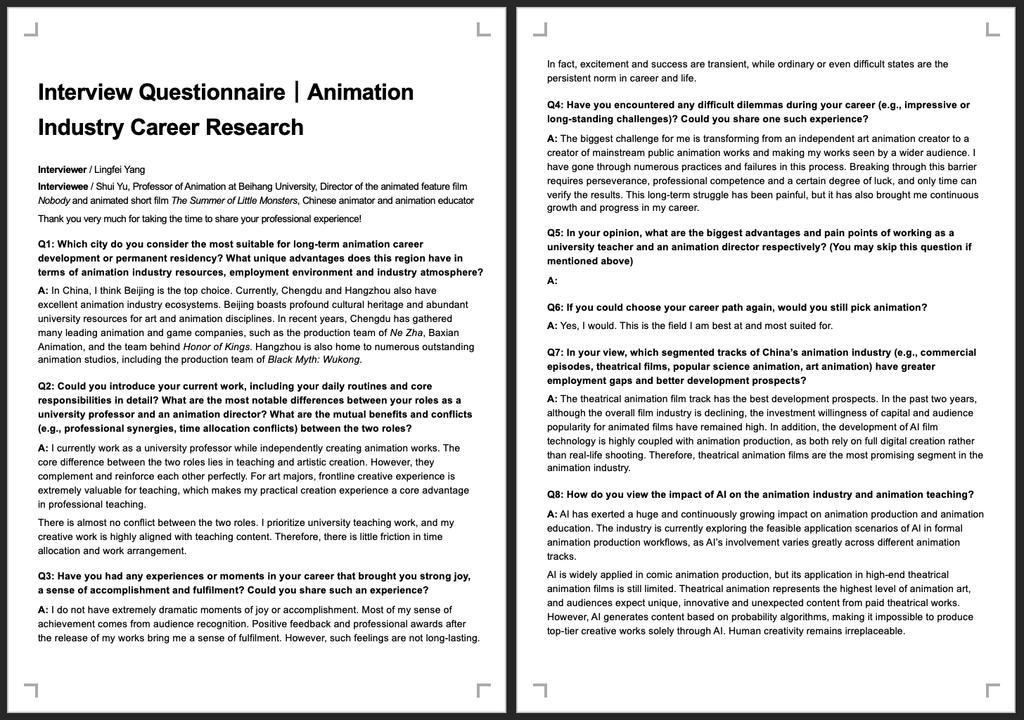
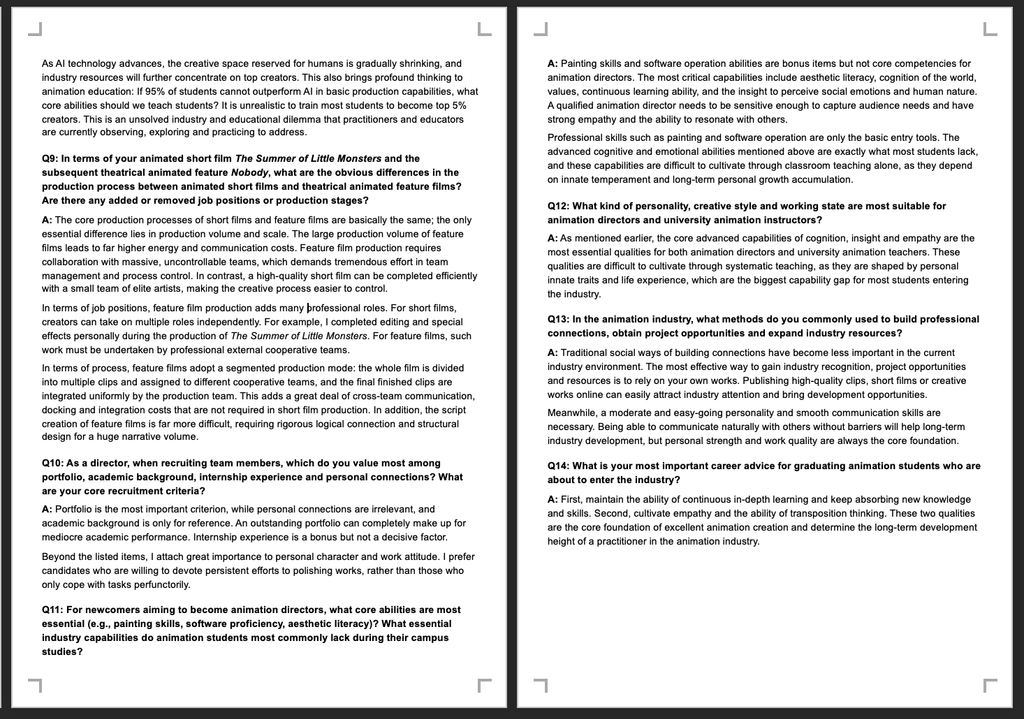
    The Interview with Shui Yu

    According to Yu Shui, Beijing, Hangzhou and Chengdu are the main cities with rich animation industry resources in China. He believes animated feature films have great development potential in China. This industry can keep growing with stable investment and a large audience market. In addition, university teaching and personal creative work can support and improve each other. However, university teachers also face heavy pressure from academic research projects and regular assessments.
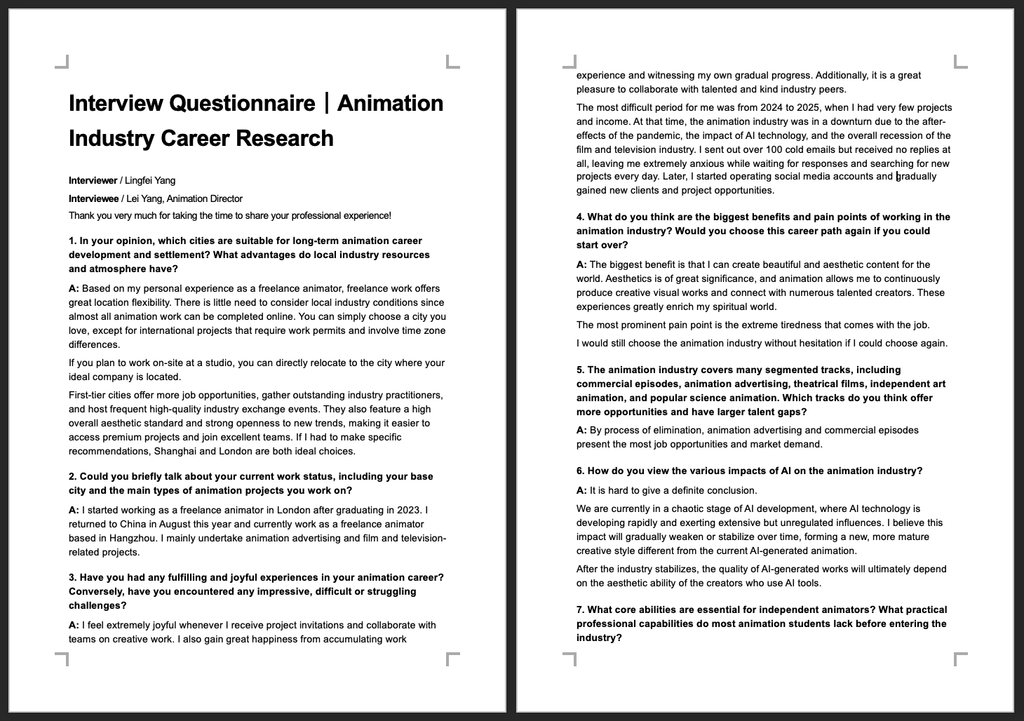
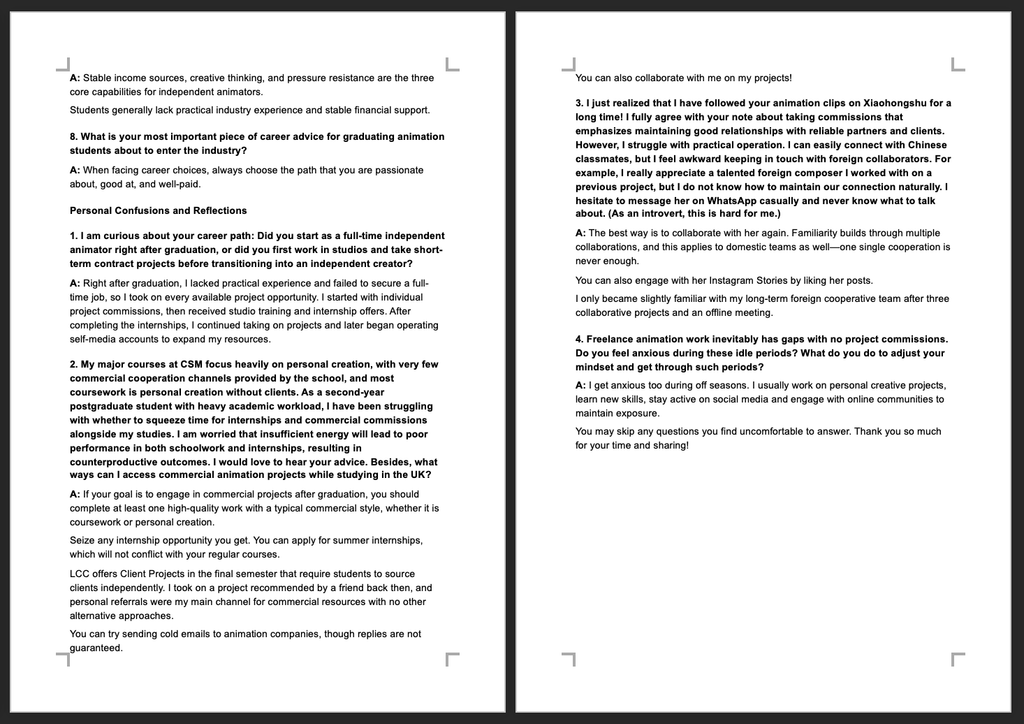
    According to Lei, full-time studio work and freelance animation work are very different. People who take full-time studio jobs need to live in the city where the company is located. In contrast, most freelance animators can work remotely. She thinks commercial advertisements and animation series are the easiest project types for freelance animators to get.

    Yang Lei prefers freelance work because it brings her creative freedom. She can freely choose the projects she is interested in. At the same time, she also talked about the disadvantages of freelancing: long gaps between projects, unstable income, and no reply when actively sending job application emails.

    I am interested in animated feature films and independent animation. I also have a strong passion for commercial animation and advertising animation projects. I once took an internship at an advertising company in China. I think it is very meaningful and interesting to use animation creativity to show the charm of products.

    When I create totally free personal works with no clear rules, I often feel confused and do not know what to create. In comparison, projects with clear goals and clear creative requirements can motivate me better. These projects bring me new inspiration and let me explore new creative ideas.

    I have no plan to become a Chinese university animation teacher for now. Although teaching and creation can promote each other, university teachers face strict and excessive academic assessments, which is a common pressure in Chinese universities. I do not want to be restricted by such rigid assessment rules.

    Freelance animation work has unstable income, but I still prefer this career path if I return to China to work in the future. I like the flexible working mode and creative freedom of remote freelance work. I am also thinking about finding a balanced career choice between full-time studio work and completely independent freelance work.
  • Post 2: Primary Research on UK Stop-Motion Practitioners

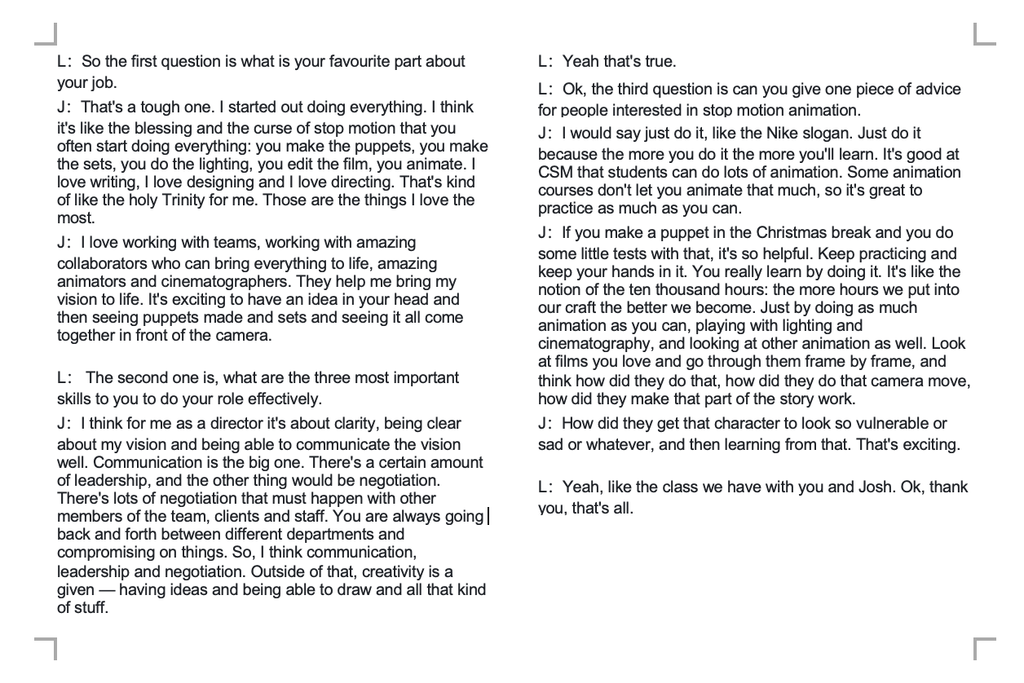
    This post focuses on two animation practitioners from the UK. The first one is Joseph, who works as a stop-motion director and animation tutor. The second one is Sacha, an animation filmmaker and animation tutor.

    I chose these two interviewees because they are local animation workers in the UK. After finishing the research for Post 1, I became interested in freelance animation work. My study in Unit 2 also made me more interested in stop-motion animation. Comparing their working experiences with Chinese animators in Post 1 helps me better understand different animation career paths.

    The interview with Joseph Wallace

    In Joseph’s sharing, he loves script writing, art direction and team-based directing work the most. He believes that communication, leadership and client negotiation are essential skills for animation directors. He also thinks hands-on practice is extremely important for animation learners to improve their abilities.

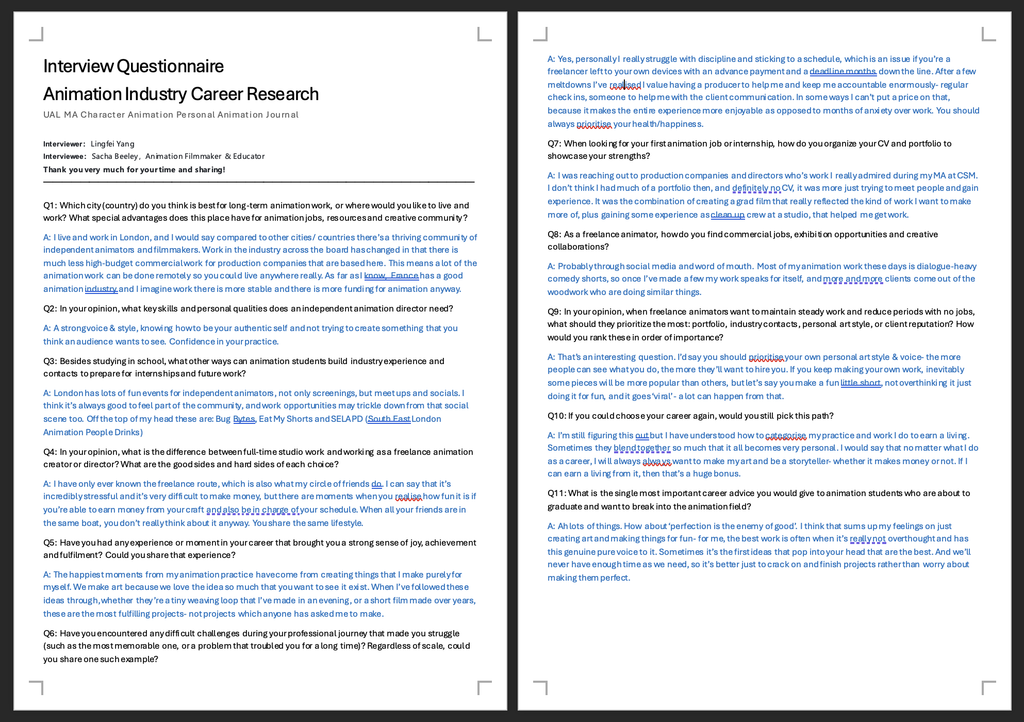
    The interview with Sacha Beely

    According to Sacha, London has an active community for independent animators. However, large-budget commercial animation projects in the UK are becoming fewer, and remote working has become very common in the industry. She also mentions that France offers more stable animation jobs and sufficient public funding for animation creation.

    Sacha has long worked as a full-time freelance animator. She admits that freelance work brings financial pressure and instability. Even so, she really enjoys this working mode, because she can arrange her own working time and make a living by doing creative work. For her, the most satisfying works are personal projects created by herself, instead of projects assigned by clients.

    Self-discipline and time management are her biggest challenges as a freelancer. It is hard for her to stick to schedules and finish work on time alone. Therefore, she thinks working with a producer is very helpful. Producers can help her arrange work progress and communicate with clients, which greatly reduces her working pressure and anxiety.

    Sacha believes that animators need to form their own unique art style first. Most of her work opportunities come from industry communities, social media and word-of-mouth recommendations. Her most important advice for new animation graduates is that “perfection is the enemy of good”. It is more important to finish a complete project than to keep pursuing perfect details endlessly.

    These two interviews show the real working situation of stop-motion animators in the UK. Similar to Lei in Post 1, Sacha also faces unstable income, which is a common problem for freelance animators in both China and the UK.

    Sacha gets many job opportunities through social media, but I have no experience in operating social media accounts and promoting my own works. This is a key skill I need to learn and improve in my future study and practice. On the positive side, I am good at making plans and managing my time, so I think I can adapt to the time management requirements of freelance work.

    At the same time, I still do not have a clear and stable personal art style. I plan to keep creating continuously to form my own creative features. Whether I choose to work in the UK or return to China in the future, building industry connections and forming my own artistic style will be the core goals of my career development.

  • Post 3: Secondary Research on Stop-Motion Animation Industry

    This post is based on animation interviews and journals I read from Zippy Frames and Skwigly. I grew up watching and learning about 2D animation, so I have a good basic understanding of it. However, I did not know much about stop-motion animation before. I slowly became interested in stop-motion and learned related skills through my Unit 2 study. Therefore, this secondary research helps me learn more about the real stop-motion animation industry and freelance stop-motion creators’ working situations.

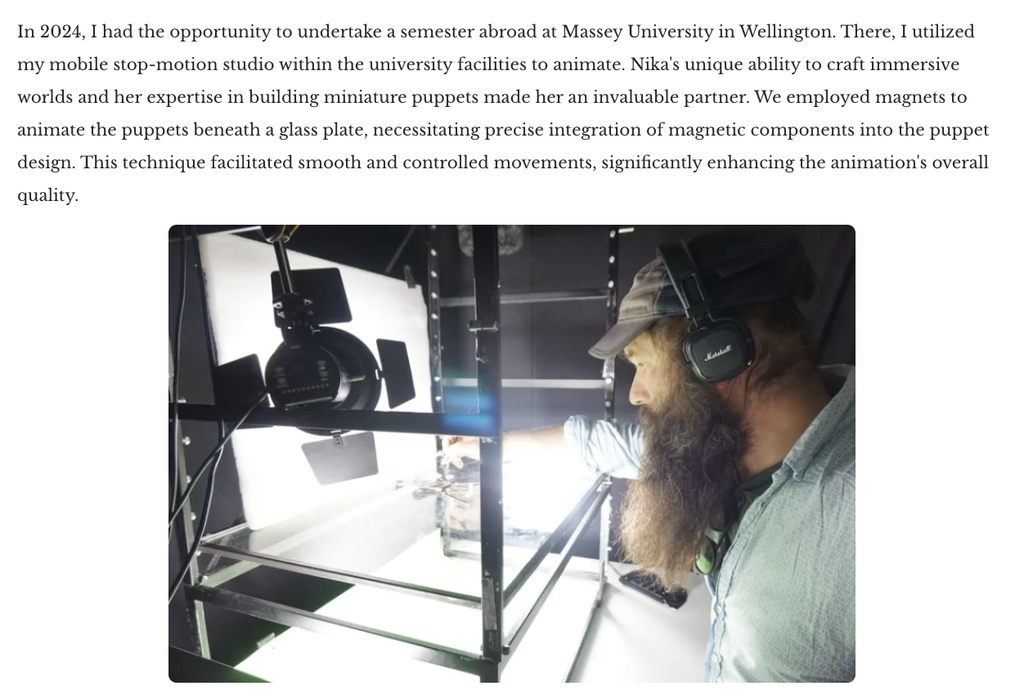
    From these readings, I found many practical difficulties for independent stop-motion animators. Many creators struggle to get funding for their projects. Without enough financial support, it is hard for them to find suitable shooting places, professional equipment and production materials. For example, German animator Marcus Grysczok finished his stop-motion works with the help of studio equipment from his university, because independent creators lack personal professional production conditions.

    The section about the production space in the interview for Perfect Sense by Marcus Grysczok

    So I think getting funding is also an important skill. With enough funding, many practical problems can be solved easily.

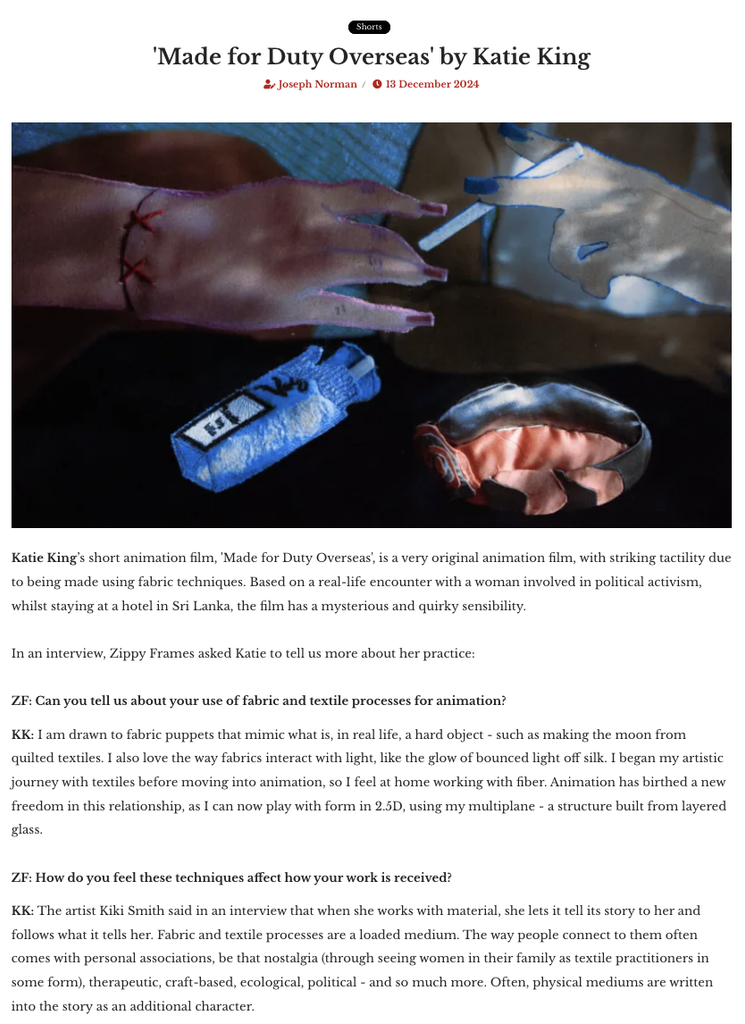
    In addition, Marcus Grysczok mentioned that his personal animation style was formed through continuous experimentation and gradual exploration, not built in a short time. This matches Sacha’s idea in Post 2, which means a unique personal art style needs long-term creation and practice. I also gained new inspiration from artist Katie King’s work. She believes animation materials such as fabric can become part of the story. These special materials carry unique emotions and memories, and help creators enrich the theme of their works.

    The section about material usage in the interview for Made for Duty Overseas by Katie King

    Focusing on combining materials with animation. This is something I’ve been interested in since I started stop-motion.

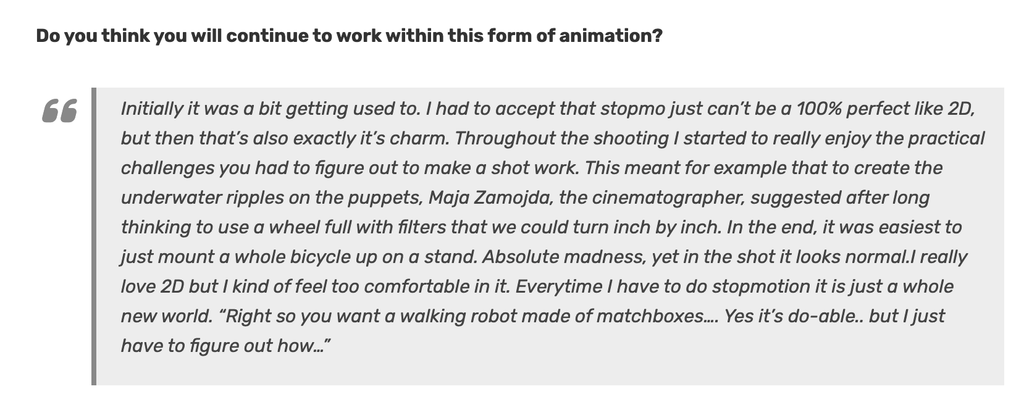
    Moreover, according to the interview with animator Bianca Ansems, stop-motion animation cannot be as perfect and smooth as 2D animation, and this kind of imperfection is exactly its unique charm. Stop-motion creation requires creators to solve various practical problems during shooting.

    The section discussing the differences between 2D animation and stop motion in Playing Ghost. An interview with NFTS graduate Bianca Ansems

    This is what I felt from my two stop-motion projects, LIAF and 1min. But these various practical problems are not all roadblocks to me. They are exciting, and I can learn things from other areas to build up my general skills.

    So I’m interested in almost all jobs in the whole stop-motion making process. If I have to choose my favourite or what I do best, it is probably the animation part. I feel the happiest when the models start moving. Next is post-production. While making my 1-minute film, I learned to use professional editing software. I found they can make many surprising effects, which is really fun. But I haven’t practised much yet. I will see if I really like it and am good at it when I work on my final film.

    She also said London has a high-level animation industry environment and more professional opportunities for new animators, which is consistent with my own study experience in the UK.

    This secondary research lets me understand the unique difficulties of stop-motion freelancers, including funding pressure, limited shooting conditions and long pre-production cycles.

    At present, I have basic stop-motion production skills and solid 2D animation knowledge. I also have the chance to contact the local animation community in London. However, I still have many shortcomings. I only have completed a complete stop-motion short film independently. I do not have my own shooting venue and equipment, and I have not formed my own stable animation style yet. I also know little about applying for project funding.

    Based on these findings, I plan to find internships in stop-motion studios first to accumulate practical industry experience and solve the problem of insufficient shooting experience. After gaining enough professional skills and industry resources, I will consider becoming an independent freelance stop-motion animator in the future.

    At the same time, I know I need to improve my English. This term, I’ve tried to talk in English with great animators I met in London and Brighton. But I still sometimes fail to understand parts of what they say, or struggle to express my ideas clearly right away. English communication is an important bridge for me to take in knowledge and share ideas here in the UK and in the future. So I need to make this bridge stronger and broader.

  • Hello world!

    Welcome to myblog.arts. This is your first post. Edit or delete it, then start blogging!